Free English consultation · Three medical directors on-site · Gangnam, Seoul
Petit · Dermotoxin

Skin Botox in Gangnam, Seoul — Dermotoxin for Oil, Pores and Surface Texture

Dermotoxin is the shallow, spread-out use of botulinum toxin type A, and at G Clinic the person holding that needle is one of three resident medical directors: Dr. Hong Seung-hyuk, Dr. Maeng Woo-jae and Dr. Hong Yeong-ho, board-certified Family Medicine specialists working in aesthetic dermatology. The full face carries a single published rate, you sit awake under local anaesthesia, and you walk out with your day intact.

  • ✦Clinic-reported 20,000+ petit procedures since 2006, with intradermal toxin among the routine requests
  • ✦Three resident medical directors, each a board-certified Family Medicine specialist, injecting personally
  • ✦Free consultation, English spoken in the room, a Gangnam address in Seoul, Korea
20,000+
Lifting & petit cases
clinic-reported, since 2006
3
Resident Directors
Family Medicine specialists · aesthetic dermatology
10
Languages
messenger support

What does skin botox in Korea actually change about your skin?

Skin botox, listed here as Dermotoxin, works on the surface of the skin far more than on your expressions. A dilute preparation of botulinum toxin type A is delivered through dozens of very shallow entry points spread evenly across a treated area, so it stays within the skin and above the muscle bellies that a conventional wrinkle appointment aims at. At that depth it reaches the small glands that produce oil and sweat, along with the fine fibres that anchor the most superficial muscle into the underside of the skin. Faces treated this way usually read as less shiny by the afternoon, with pore openings that cast less shadow and a smoother look under direct light. Deep folds, lost volume and a wide jaw sit outside its reach entirely. A director examines your skin and confirms the published full-face rate at a free consultation in Gangnam, Seoul.

The Visit

What a Dermotoxin appointment in Gangnam looks like, stage by stage.

Four stages, from a director reading your skin under a lamp to the point where you are told what may go on your face tonight.

  1. 01

    Reading oil, pore pattern and skin thickness

    A director looks at your skin under a lamp and, where it helps, in a magnified image, checking how much shine has returned since you washed, where the enlarged openings cluster, and how thin or thick the skin feels when pinched. Skin that shines across the T-zone and stays matt at the cheeks is treated as two different problems on one face. Your health history, medication list and any injectable work done elsewhere are recorded in the same sitting, and the consultation costs nothing.

  2. 02

    Dividing the face into a treatment grid

    Because the product has to sit evenly to work evenly, the treated area is planned as a grid of closely spaced points, never as a handful of separate targets. The director decides how far apart those points sit, keeps them away from the zones where a deeper deposit would reach muscle that lifts the brow or moves the lip, and adjusts density where your skin shines hardest. A face that has been treated with toxin recently is planned around what is already in it.

  3. 03

    The shallow pass across the grid

    A very fine needle raises a tiny bleb of fluid inside the skin at each point of the grid, and the director works across the area in sequence until the whole map is covered. You stay awake and can talk the entire time; local anaesthesia is what the clinic uses, and sedation is unnecessary here, though sedation is available across G Clinic procedures at an additional cost. Most patients describe a series of small stings and a warm, prickling face for a short while afterwards.

  4. 04

    Skin instructions and the texture review

    The blebs flatten quickly and the pinpoint marks fade, so the instructions are mostly about leaving your face alone: no rubbing, no facial massage, no sauna and no hard training for the period your director specifies, and stay upright for the rest of the day. A review is arranged because a texture result declares itself slowly, and a director wants to see whether any zone was treated too lightly once the skin has settled.

The Mechanism

Why depth is the whole difference between skin botox and muscle botox.

The same molecule can do two unrelated jobs depending on where it is put. Placed deep, into the belly of a muscle, botulinum toxin type A quiets a large contraction and a crease stops being folded. Placed shallow, inside the dermis and spread thinly over a wide surface, it never reaches that muscle in any meaningful concentration, and what it meets instead is the small anatomy of the skin: sebaceous glands, sweat glands, and the delicate fibres by which the outermost sheet of facial muscle attaches to the skin above it.

Dialling those down produces a different set of visible changes. Less oil arrives at the surface, so the skin holds a matt finish for longer through the day. A pore opening looks smaller when it is producing less and when the skin around it is under slightly more even tension, though the opening itself has not been closed or shrunk. The fine, shallow crepe that shows up on a cheek in raking light softens because the surface is being pulled a little more smoothly.

The boundaries follow from the same logic. A fold that is visible in a photograph of a completely relaxed face is a structural crease and needs something else. A hollow temple or a flattened cheek is a volume question. A square lower face is a muscle question. The full range of toxin services at this clinic, and how the three are separated, is set out on the botox in Gangnam hub; this page stays inside the skin.

The Target

Shine, pore openings and fine surface lines: what Dermotoxin is aimed at.

Shine is the complaint that brings most people to this treatment. Skin that is matt at breakfast and reflective by lunch is producing oil faster than the surface can carry it, and make-up applied over it slides, separates and needs blotting through the day. Reducing that output changes how light bounces off the face, so photographs taken under a bright ceiling read differently long before anyone can point to a specific line that has gone.

Pore appearance is the second reason people ask. An opening looks large when it is full, when the skin around it has lost some of its even tension, and when a shadow falls into it. Dermotoxin can influence the first two of those, so an opening reads as tighter and less obvious in a mirror held at arm's length. It does not remodel the structure of a pore, and any patient who is told otherwise should be sceptical.

The third target is the fine, shallow creasing that appears on the cheek, around the mouth and under the eye in strong side light. This is surface texture, and it responds to a small, evenly distributed relaxation of the most superficial fibres. Where the concern turns out to be a fold that stays put on a completely still face, the answer is volume and the dermal filler page describes that route instead.

Suitability

Who a director treats with intradermal toxin, and who is refused.

The patient this suits is an adult in reasonable health with skin that runs oily or combination, visible pore openings across the nose and inner cheeks, and a surface that photographs as shiny and slightly uneven. Wanting a matt finish that survives an afternoon of walking around Seoul is a perfectly sensible goal, and so is wanting make-up to sit still.

Several groups are declined on the spot and told the reason. Anyone pregnant or breastfeeding waits. Neuromuscular disease is a firm exclusion, myasthenia gravis included, and so is any related disorder affecting how nerve signals reach muscle. Active infection, an inflamed acne outbreak or broken skin across the intended grid postpones the appointment until the skin has calmed, since a shallow injection through inflamed tissue is a poor idea. A current course of aminoglycoside antibiotics also postpones treatment, because that group can amplify the effect on muscle.

Then there are the refusals patients find harder to accept, and directors here give them plainly. Someone whose skin is already thin, dry and tight is told that reducing oil output further can leave the face uncomfortable, and is sent away with skin-barrier advice in place of an appointment. Someone pointing at a deep nasolabial fold is told that no amount of surface work will lift it. Someone who wants pore openings made structurally smaller for good is told that this treatment cannot deliver that, in those words. And a patient whose real complaint turns out to be a wide, muscular lower face is redirected to the jaw botox page, since that is a different depth, a different muscle and a different quotation. Nobody is asked to book on the day, and walking out having been told no is a normal outcome of a consultation here.

Results

What changes in the mirror after skin botox, and when it fades.

Nothing has happened by the time you reach the street, and the first thing most people notice is not on their face at all: it is that the blotting papers stay in the bag. Oil output falls away over the days that follow, and a matt afternoon arrives well ahead of any change you could point to in a still photograph. Patients who fly home two days later and inspect their pores are looking far too early.

Once it has settled, the effect reads as a quality of surface. Skin catches light more evenly, so cheeks that used to flare white under a ceiling lamp look calmer; make-up sits where it was put; the fine crepe that showed at the side of the eye in raking light is less obvious. It is deliberately quiet work, and patients comparing before-and-after photographs of skin botox usually spot the difference in the way the light falls before they spot any individual line. Results vary between patients, and any case photographs a director shows you in the consultation room are shared with the consent of the patient in them.

All of it is temporary. Nerve endings recover, glands return to their previous output, and skin drifts back towards the way it behaved before, so this is planned as a repeating appointment. How long an individual holds the result depends on how active their skin is, how much surface was covered and their own physiology, and a director gives you a personal expectation at the review appointment instead of a number taken off a chart.

Safety

What can go wrong with a full-face intradermal session.

Every part of this carries genuine medical risk, and a director talks you through the list at the examination, ahead of any consent form. Bruising leads the list, and it deserves emphasis here more than anywhere else in this family of treatments: a grid means many more punctures than a conventional appointment, so pinpoint bleeding and small bruises are common, and around the eye they can be the size that needs covering for several days. Redness, small raised wheals at each entry point and a warm, tight face are usual for the first hours. Headache in the first day or two is reported often enough to expect.

The complication specific to this technique is depth. If a deposit travels deeper than intended, it stops behaving like skin treatment and starts behaving like muscle treatment, and the face nearest the mouth is where that shows: an uneven smile, a lip that moves differently on one side, or a weakened seal when you drink. Near the eye and brow, a deeper deposit can leave a lid feeling heavy or a brow sitting lower than its twin. Patchiness is the other failure mode, where one zone of the grid responds more than the neighbouring one and the face looks unevenly matt. Some patients find their skin drier and tighter than they wanted. Infection at puncture points is uncommon and possible. Occasionally the response is barely perceptible.

Most of these settle as the effect wears off, and a temporary problem is still a real one while it lasts, since a crooked smile can sit with you for weeks. Stay upright for several hours, keep massage, scrubs and heat off the treated skin for the period your director specifies, and contact the clinic if your smile changes shape, if a bruise keeps growing, or if pain or redness climbs after the first day. One of the three directors is in the building for every hour the clinic is open. Sweat-gland effects are the point of a different service entirely, and the separate cautions for that are on the underarm sweat botox page.

Downtime

Make-up, flights and the day after a Dermotoxin session.

There is no recovery period in the ordinary sense. The blebs raised during the session flatten within the hour, the pinpoint marks fade, and almost everyone carries on with an afternoon of shopping or a meeting the same day. Make-up is the one thing worth planning around: a director will tell you how long to leave the skin bare, and turning up to a dinner on the evening of treatment with a lightly speckled face is a real possibility.

Bruising is what can outlast the day. Anyone taking blood thinners or fish oil, and anyone who drank the night before, marks more readily across a grid of this density, so tell the clinic in advance if you have photographs, a wedding or a work event in the days ahead. Cold air and hot saunas are both better avoided for the period your director names, and the public bathhouse on the itinerary is worth moving to the end of the trip.

For international patients the timing question is about the review. A texture result is slow and quiet, so a short trip rarely covers both the session and a settled outcome, and our coordinators either keep the review in a longer itinerary or arrange it for a later visit. This appointment sits easily alongside anything else on a Seoul trip because it costs no downtime, and patients treating the shoulder line on the same journey usually book both together, as the trapezius botox page explains.

Comparison

Skin botox against the other ways to change how a face looks.

Three injectable routes aimed at three different problems, laid out so your consultation opens on the right question.

At G Clinic Skin botox (Dermotoxin) Expression-line toxin Hyaluronic acid filler
Where it is placedInside the skin, across a gridInto the belly of one muscleUnder the skin, where volume is missing
What it acts onOil and sweat glands, superficial fibresA large muscle of facial expressionThe shape of the tissue itself
Usual complaintShine, pore openings, fine surface crepeForehead bands, frown furrow, eye-corner linesHollows, flattened contour, folds at rest
Entry points per sessionDozens across the treated surfaceA few per treated areaOne or two per site
AnaesthesiaLocal, awake; sedation optional at extra costLocal, awake; sedation optional at extra costLocal, awake; sedation optional at extra cost
When it readsQuietly, over the first weeksOver the days after treatmentStraight away, refining as swelling settles
Quoted asOne published rate for the full faceBy the number of areas treatedBy product and site
Poorly suited toFolds that need volume put backCreases fully etched at restOiliness and surface texture

This table is general information. Which route suits your face depends on your skin, your anatomy and your health, and a resident director works through it with you at the free consultation.

Scientific Evidence

What the published record on botulinum toxin sets out.

Botulinum toxin type A has been examined in the peer-reviewed literature for decades, and three papers indicate the kinds of question that literature asks. One is a meta-analysis of neutralising antibody conversion with onabotulinumtoxinA across multiple indications (Naumann, 2010). A second reports the measured content of botulinum neurotoxin in several marketed preparations, which is the ground any comparison between formulations has to stand on (Frevert, 2010). The third is a meta-analysis of individual patient data drawn from global clinical registration studies in 1678 participants, examining the safety and tolerability of onabotulinumtoxinA in the treatment of facial lines (Brin, 2009). These papers describe the substance and its record as a category. None of them reports outcomes at G Clinic, none of them concerns the intradermal technique described on this page, and none of them predicts what your own skin will do, which belongs in the consultation room.

  1. Naumann M, et al. Meta‐analysis of neutralizing antibody conversion with onabotulinumtoxinA (BOTOX®) across multiple indications. Movement Disorders. 2010. doi:10.1002/mds.23254
  2. Frevert J. Content of Botulinum Neurotoxin in Botox®/Vistabel®, Dysport®/Azzalure®, and Xeomin®/Bocouture®. Drugs in R&D. 2010. doi:10.2165/11584780-000000000-00000
  3. Brin M, et al. Safety and tolerability of onabotulinumtoxinA in the treatment of facial lines: A meta-analysis of individual patient data from global clinical registration studies in 1678 participants. Journal of the American Academy of Dermatology. 2009. doi:10.1016/j.jaad.2009.06.040
Pricing

How skin botox in Seoul, Korea is quoted at this clinic.

Dermotoxin occupies its own line on the price list, separate from expression-line work and separate from the jawline service, and the full face is treated as a single item at a published rate that applies to everyone who walks through the door. There is no count of areas to negotiate and no different figure for visitors from abroad. What a director settles at the examination is whether your skin should be treated at all, and the quotation is confirmed at the free consultation.

TreatmentOptionPrice (KRW)
Skin Botox (Dermotoxin)Full face₩330,000

All prices in KRW, VAT included. Quoted at consultation; final cost depends on treatment plan. Published rates as of 2026-09-08.

Get Your Personalized Quote

FAQ

Skin botox and Dermotoxin — your questions.

What is the price of skin botox in Korea at G Clinic?

Dermotoxin carries one published rate covering the full face, listed separately from expression-line areas and from the jawline treatment, so there is no per-area arithmetic to work through. That published rate applies to every patient equally, with no separate figure for international visitors and nothing to negotiate at the desk. A director confirms the quotation at the end of your free consultation, and you can request it in advance through the consultation form.

How is skin botox different from the botox everyone talks about?

Depth, dilution and distribution. Conventional treatment puts a concentrated dose deep into one muscle to stop it folding the skin above it. Dermotoxin puts a dilute preparation shallowly inside the skin at dozens of closely spaced points, where it meets oil glands, sweat glands and the finest superficial fibres. The result is a change in surface quality and shine, and the wider family of services is compared on the botox hub.

Will it actually make my pores smaller?

An opening can look smaller without being made smaller, and that distinction matters. Less oil sitting in a pore and slightly more even tension in the surrounding skin both reduce the shadow a pore casts, so it becomes less obvious in a mirror and in photographs. The structure of the pore itself is unchanged, and any promise that this treatment rebuilds pore architecture is worth treating with suspicion.

Are there photographs showing how it turned out for other patients?

A director can show you relevant case photographs in the consultation room, taken before and after treatment, and only where the patient in them has consented to that use. Nothing of the kind is published on this page for an intradermal result, because a change in shine and surface texture depends heavily on lighting and photographs of it are easy to misread. Results vary between patients in any case.

How soon does the effect show, and how long does it last?

It is the quietest treatment in this family and the least dramatic to watch. Oil output usually eases first, over the days after your appointment, and the change in surface texture settles gradually after that. The effect is temporary in every case, since nerve endings recover and glands go back to their previous output, so a director plans it as a repeating appointment and gives you a personal expectation at the review.

Will my face stop moving or look frozen?

That is not what this technique is designed to do, because the product stays inside the skin and is far too dilute at that depth to switch off a muscle of expression. Patients generally report that their face moves exactly as it did. The one situation where expression is affected is a deposit that travels deeper than intended, and the mapping stage exists to keep the grid away from the zones around the mouth and brow.

My skin is dry already. Should I still consider it?

Probably not, and a director here will say so. The mechanism reduces oil arriving at the surface, so a face that is already dry, thin and tight can end up more uncomfortable than it was, with make-up clinging and the skin feeling rough. If dryness is your complaint, the consultation goes towards barrier care and hydration instead, and you leave without an appointment booked.

Who should not have this treatment at all?

Anyone pregnant or breastfeeding, for the time being. Anyone carrying a neuromuscular diagnosis, myasthenia gravis or a related disorder of the nerve-to-muscle junction among them. Anyone with an active infection, an inflamed acne outbreak or broken skin over the intended area, which postpones the appointment until the skin has settled. A current course of aminoglycoside antibiotics also postpones treatment, since that group can amplify the effect on muscle.

Does a grid of injections mean more bruising?

Yes, and it is the single most common thing patients report after this appointment. Many entry points across a face mean many chances of a small bruise or pinpoint bleed, and the skin around the eye bruises most readily of all. Alcohol the night before, fish oil and blood-thinning medication all make it more likely, so tell the clinic in advance and avoid scheduling the session immediately ahead of an event.

Can it make my smile uneven?

It is uncommon and it is a genuine possibility, and it happens when a deposit reaches deeper than intended near the mouth, where the muscles that move the lip and lift its corner sit close to the surface. The result can be a smile that pulls unevenly or a lip that seals less well when you drink. Keeping the grid shallow and away from those zones is exactly why the marking stage is done carefully, and the effect resolves as the treatment wears off.

Which product is used for the injections?

Product names are not published on this website, in line with Korean advertising rules covering prescription medicines. Your director can discuss the preparation with you in the consultation room, where that conversation belongs. What is used is a botulinum toxin type A preparation approved for use in Korea, diluted for intradermal delivery, and stored and handled by the medical staff under clinic protocol.

Who does the injecting, and will I be asleep?

One of the three medical directors performs it personally: Dr. Hong Seung-hyuk, Dr. Maeng Woo-jae or Dr. Hong Yeong-ho, all board-certified Family Medicine specialists working in aesthetic dermatology and all on site during opening hours. You stay fully awake under local anaesthesia and can talk throughout. Sedation is unnecessary for this treatment, though it is available across other G Clinic procedures at an additional cost.

Can I combine it with other appointments on one trip to Seoul?

Usually yes, because none of it demands recovery time, and directors plan the sequence at a single examination. Skin work often goes alongside the chewing-muscle treatment described on the jaw botox page, and patients adding body work book either G-fat fat dissolving injection or, where surgery is the better fit, liposuction in Korea on the same journey. Your director says what to leave for another visit.

Start Here

Have a director read your skin under the lamp first.

Book a free consultation and one of the three medical directors will look at how your skin behaves in person in Gangnam, Seoul, and tell you whether an intradermal course would change anything for you or whether your money is better spent elsewhere. The full-face rate is published above, and the plan is agreed face to face.

Book Consultation
Three Resident Medical Directors

Your director sees you, and performs your treatment.

Every consultation and procedure at G Clinic is conducted on site by one of three resident medical directors — never handed to a substitute practitioner. All three are Family Medicine specialists who have cared for international patients for years.

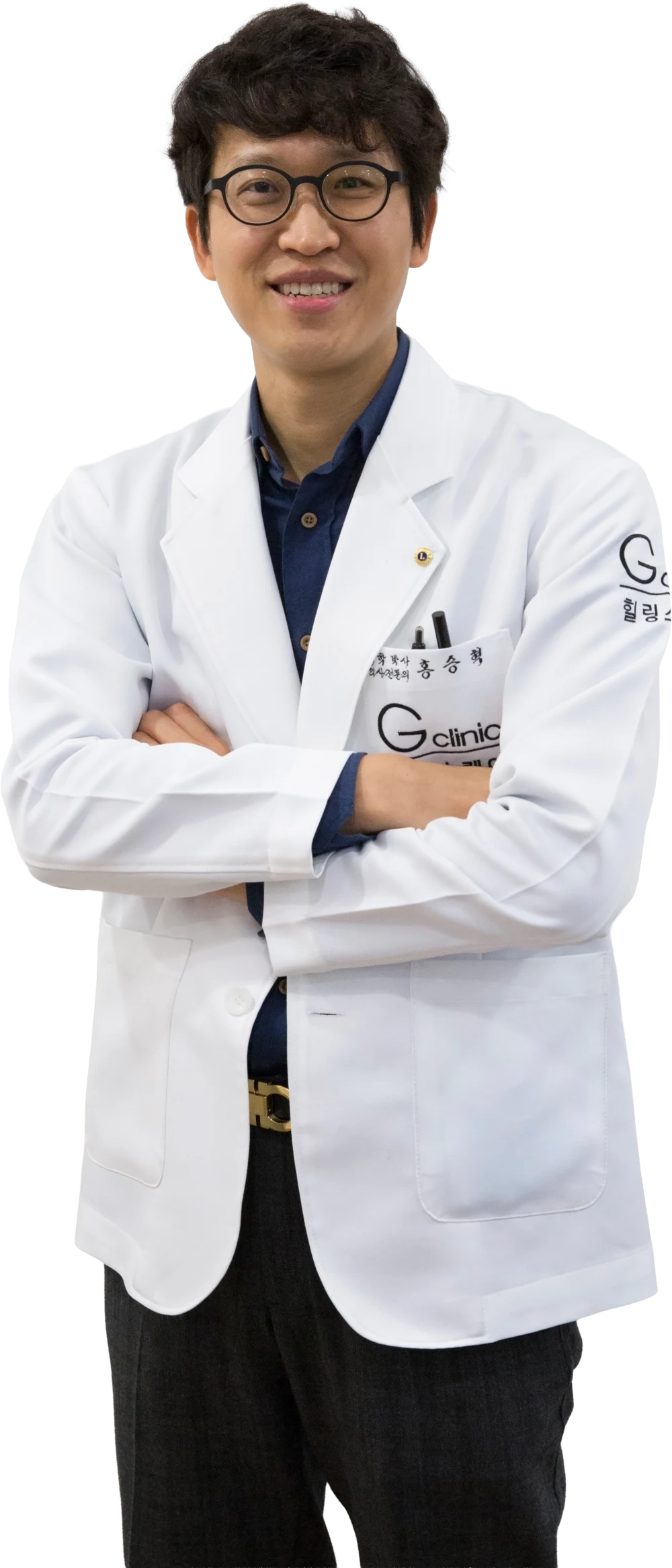
Dr. Hong Seung-hyuk, Medical Director at G Clinic, Gangnam, Seoul

Dr. Hong Seung-hyuk

Kyung Hee Univ. College of Medicine · MD, PhD
Board-certified Family Medicine Specialist · Aesthetic Dermatology
President, Korean Rejuvenation & Obesity Aesthetic Medicine Association (KORA). Co-translator, Body Shaping: Skin · Fat · Cellulite (2016).
Dr. Maeng Woo-jae, Medical Director at G Clinic, Gangnam, Seoul

Dr. Maeng Woo-jae

Kyung Hee Univ. College of Medicine · MD, PhD
Board-certified Family Medicine Specialist · Aesthetic Dermatology
President, Korean Association of Obesity Treatment (KAOT); Vice-President, Korean Anti-Aging Association. Co-author, Clinical Obesity Pharmacology (2017).
Dr. Hong Yeong-ho, Medical Director at G Clinic, Gangnam, Seoul

Dr. Hong Yeong-ho

Kyung Hee Univ. College of Medicine · MD, MS
Board-certified Family Medicine Specialist · Aesthetic Dermatology
Former KOICA international cooperation physician. Full member, Korean society for aesthetic and rejuvenation medicine.
Current Programs

Body contouring & lifting programs.

G Clinic's core programs centre on G-fat body contouring and non-surgical lifting — clinic-reported 20,000+ G-fat cases since 2018. Pricing is shared during your free consultation — the same figures are quoted to every patient, with no separate visitor markup.

G-fat · Body

G-fat body contouring course

Targeted fat dissolving injections for the abdomen, arms and thighs — planned and performed by a resident medical director. Course length is decided at your free consultation.

Explore G-fat
Lifting

Non-surgical face lifting program

Director-performed lifting treatments for jawline and facial contour, matched to your skin at consultation.

Explore Lifting
Petit

Botox & filler refinement

Precise contour refinement to complete a body or lifting course, personally administered by your director.

Explore Petit
Programs are reviewed with your director at your free consultation
Certifications & Partner Recognition

A decade of recognized clinical partnerships.

The G Clinic name dates to a 2012 device-maker advisory appointment. Each recognition below is stated as issued by its organisation.

Ulthera
Ulthera Authenticity Certified Clinic
Certified by Merz Aesthetics for authentic Ulthera equipment.
2018
Merz Aesthetics Award
Portfolio category, Merz Aesthetics, July 2018.
2018
Merz Serendipity Journey Symposium
Attendance certificate, Dr. Maeng Woo-jae, Seoul 2018.
2018
Health Chosun — Best Clinic listing
Recommended clinic feature, Chosun Media, 2018.
2013
Restylane 15 Million Club — Expert Member
Expert member recognition issued by Galderma.
2012 · 2016–2019
Hironic Advisory Appointments
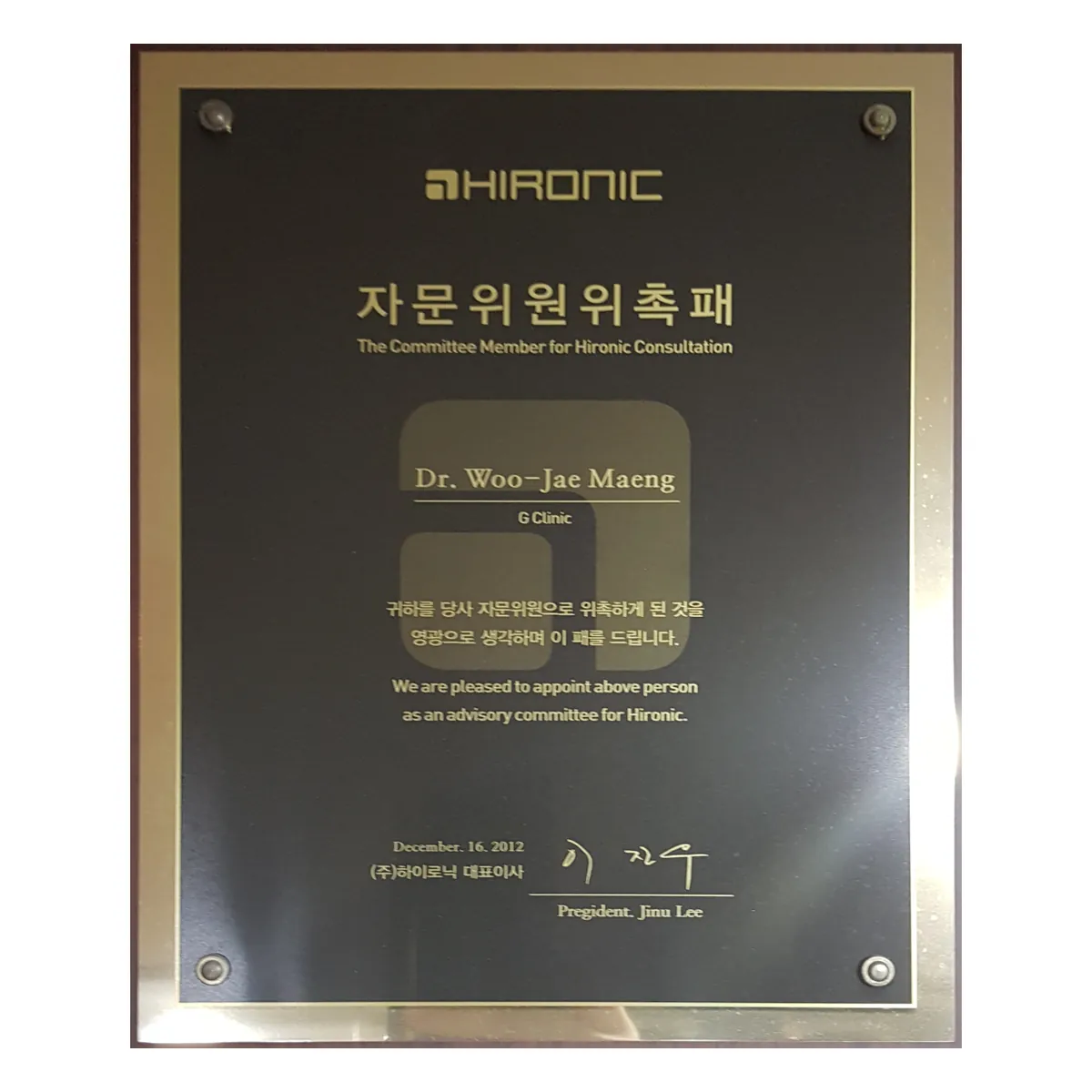
Advisory committee: Dr. Maeng (2012, certificate bears the G Clinic name), Dr. Hong Yeong-ho (2016–2019).
Doublo
Doublo HIFU Designated Clinic
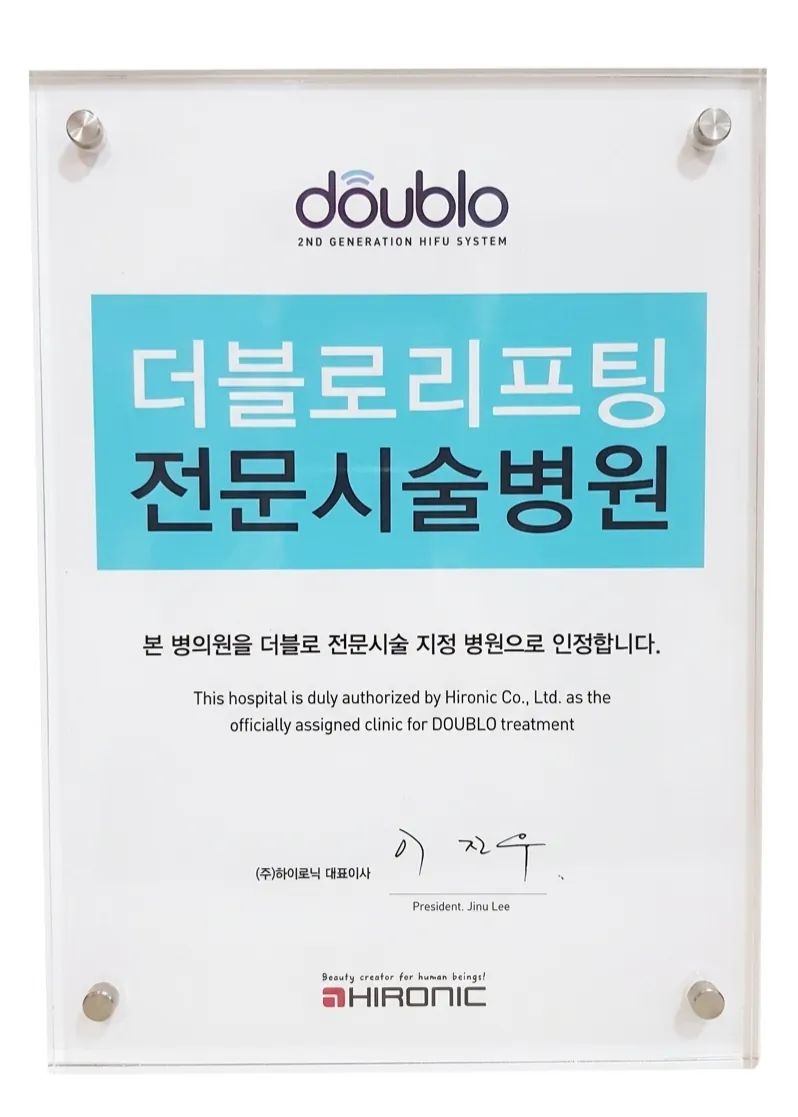
Officially assigned Doublo clinic, Hironic Co., Ltd.
Volnewmer
Volnewmer Official Certified Clinic
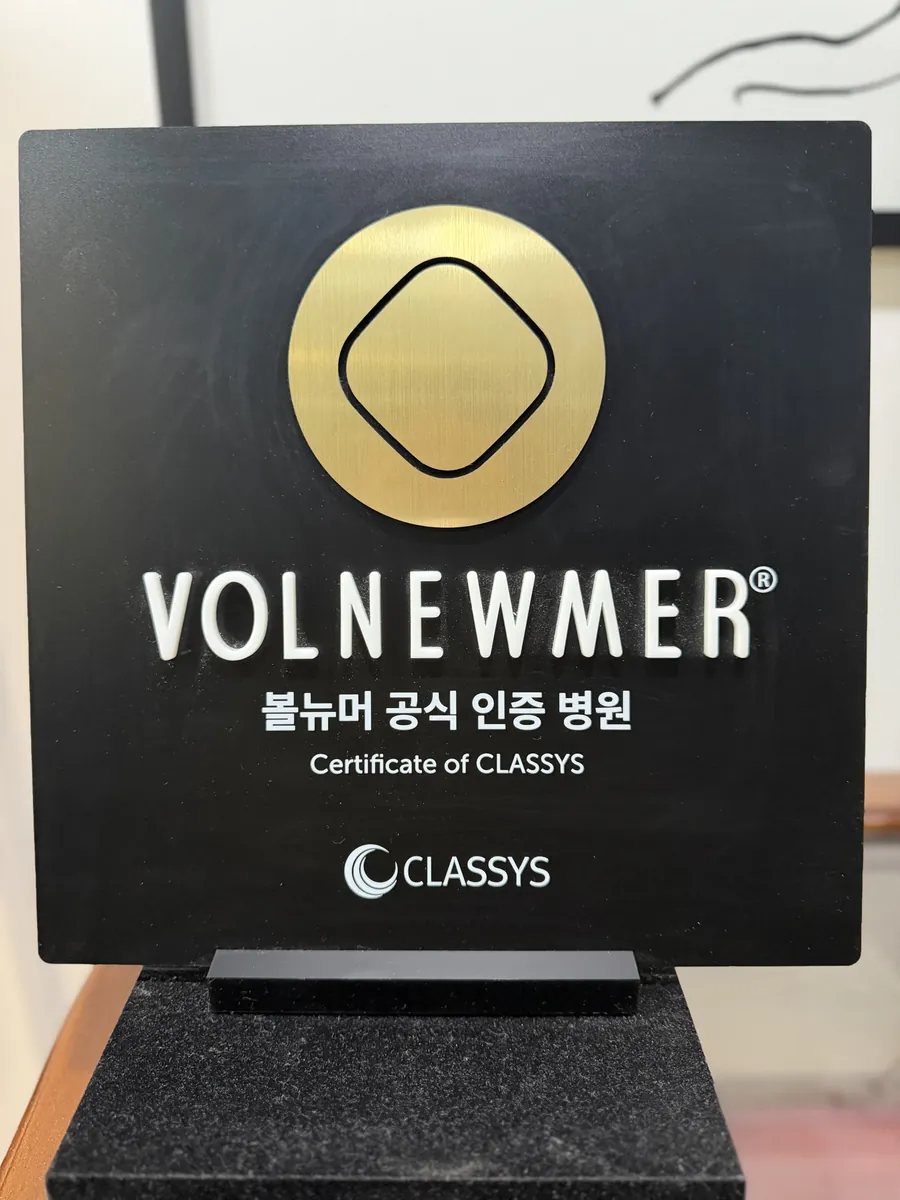
Certificate of Classys.
Juvelook
Juvelook Official Certified Clinic
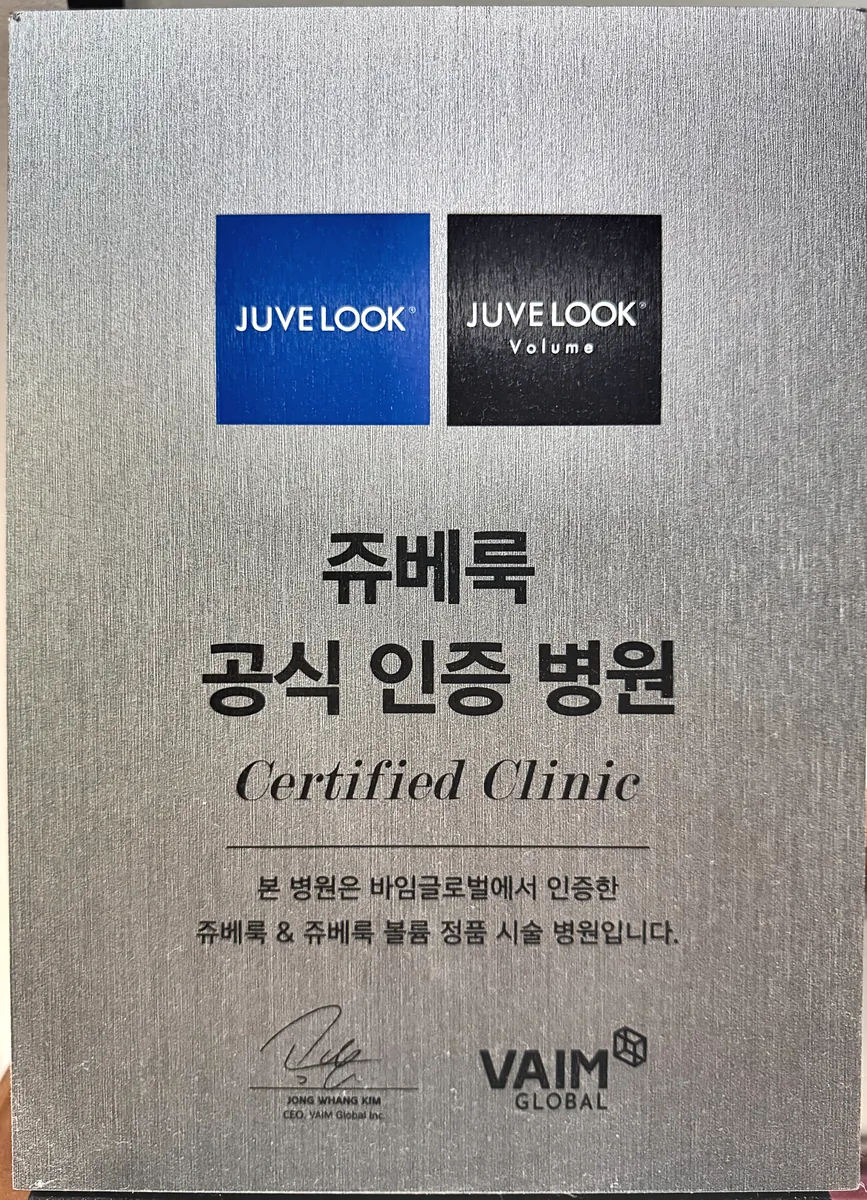
Certified by VAIM Global for authentic Juvelook treatment.
Silhouette Soft
Silhouette Soft Certified Clinic
Recognized by Sinclair for authentic Silhouette Soft thread lifting.
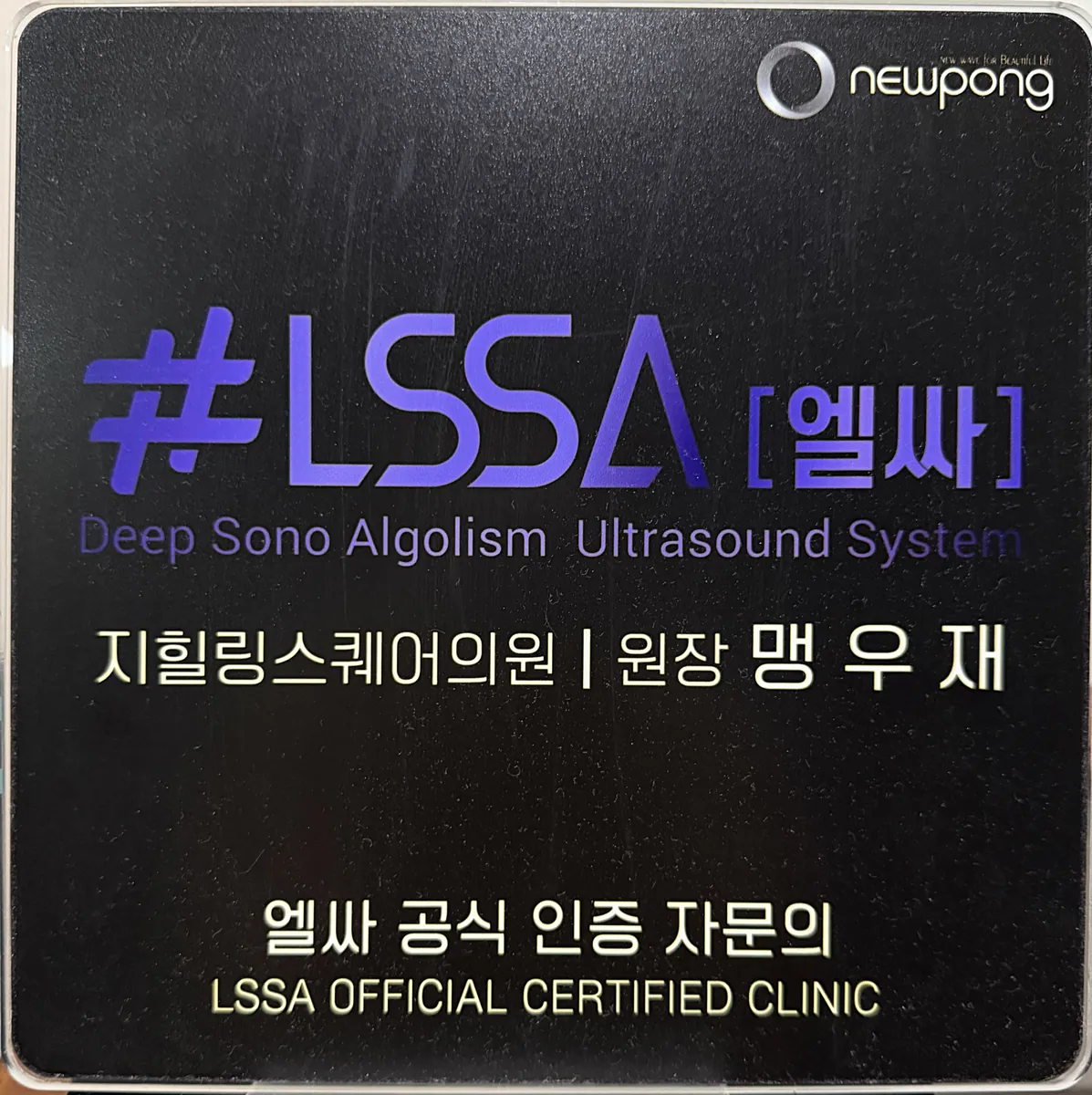
LSSA
LSSA Official Certified Clinic
Deep Sono Algolism Ultrasound System; certified advisory physician Dr. Maeng Woo-jae.
2010–2017
Academic & Society Roles
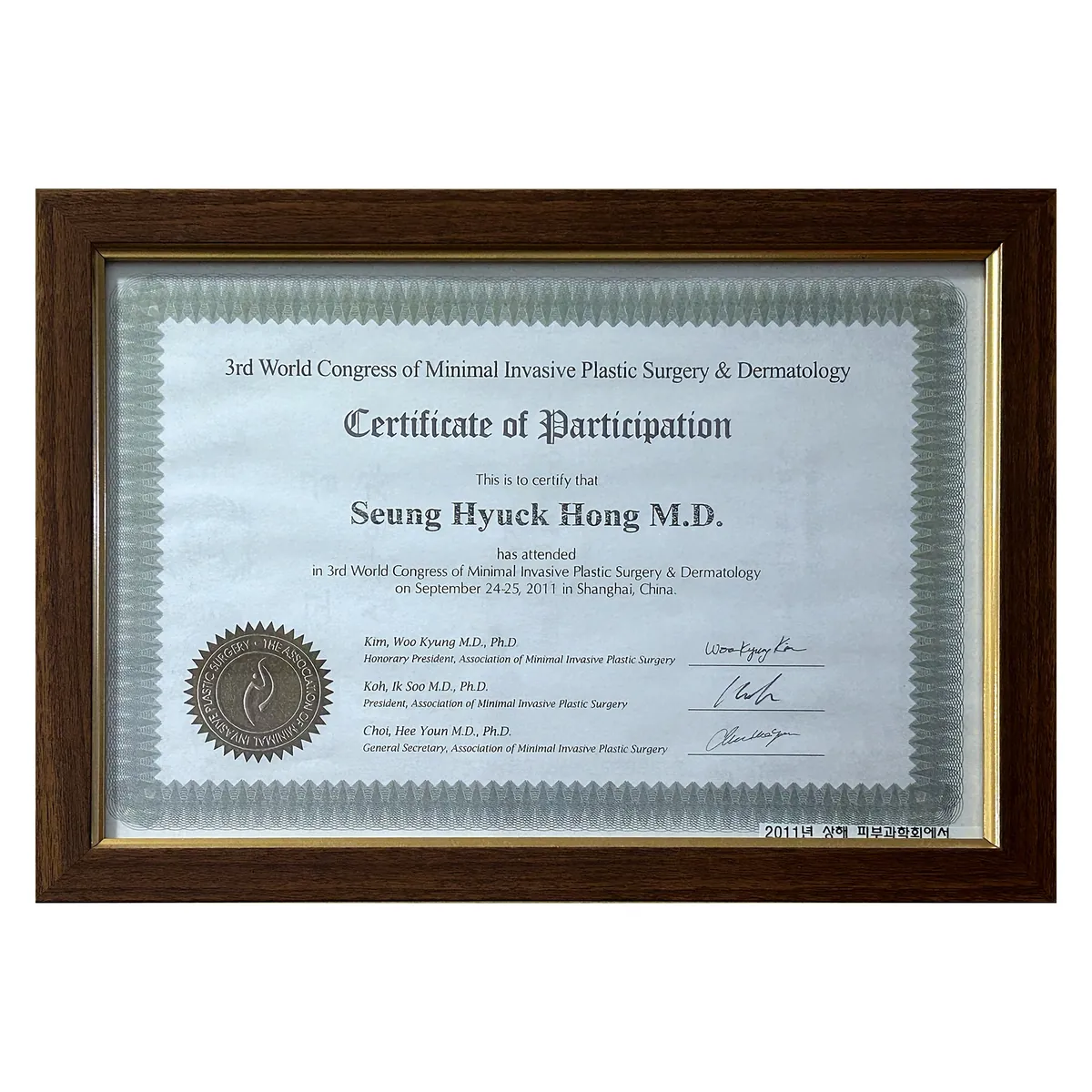
Dr. Maeng: KAOT chair, appreciation plaque 2014. Dr. Hong Yeong-ho: adjunct assistant professor, Konkuk Univ. (2013–2017). Dr. Hong Seung-hyuk: KSLMS member 2010; World Congress MIPS&D 2011.
Ulthera authenticity certified clinic certificate
Merz Aesthetics Award 2018 plaque
Merz Serendipity Journey Symposium 2018 attendance certificate, Dr. Maeng Woo-jae
Health Chosun 2018 Best Clinic plaque
Restylane 15 Million Club expert member plaque
Hironic advisory committee appointment plaque, Dr. Maeng Woo-jae, 2012
Hironic advisory appointment plaque, Dr. Hong Yeong-ho, 2016–2019
Doublo HIFU designated clinic certificate
Volnewmer official certified clinic plaque, Classys
Juvelook official certified clinic plaque
Silhouette Soft certified clinic certificate
LSSA official certified clinic plaque
KAOT appreciation plaque, Dr. Maeng Woo-jae, 2014
Konkuk University School of Medicine adjunct appointment, Dr. Hong Yeong-ho
KAOT 2013 workshop attendance certificate, Dr. Hong Yeong-ho
Korean Society for Laser Medicine and Surgery membership certificate, Dr. Hong Seung-hyuk
3rd World Congress of Minimal Invasive Plastic Surgery and Dermatology participation certificate, Dr. Hong Seung-hyuk
Patient Reviews

What our patients say.

Verified reviews from our Google Business Profile.

★★★★★

Yesterday, I had a fat extraction procedure from Dr. Hong Young-ho. The staff, especially the doctor, were so kind that it was very comfortable. Right after the procedure, it was just a little uncomfortable yesterday because of swelling, but today there is almost no pain and I'm waiting for the swelling to go away to see the beautiful res…

Ka year ago
★★★★★

Recommendations are made based on actual circumstances. The attitude is very good. Highly recommended.

Ya year ago
★★★★★

I cannot recommend G-clinic highly enough. From the moment I walked in, my experience was nothing short of exceptional. The clinic itself is modern, clean, and welcoming. The front desk staff were incredibly warm and efficient. Checking in was a breeze, and they were very helpful with my new patient paperwork. The waiting time was minimal…

ma year ago
★★★★★

Process was perfect! I got some liposuction done, the doctor and staff were very nice and very professional. 100% would recommend anyone to get there procedures done here! They took out A LOT of fat! The doctor speaks perfect English as well!

K3 years ago
Free Consultation

Get your personalized quote.

Share your details and our team will reply through your preferred messenger. Consultation is free and pricing is quoted at your free consultation.

  • ✓Free consultation reviewed by one of three resident directors
  • ✓Personalized quote at your free consultation — same figures for every patient
  • ✓Care performed on site by your director in Gangnam, Seoul
  • ✓10-language support via messenger

Book a Free Consultation

⚠ Please select a country code for WhatsApp

Your details are protected under our privacy policy and are never shared with third parties.

Chat with us
Visit Gangnam · Dosan-daero

Emerald Tower, 5F–7F.

Address
5F–7F Emerald Tower122 Dosan-daero, Gangnam-gu, Seoul, South Korea
Hours
Mon–Fri · 11:00–19:00Sat · 10:30–14:00 · Sun & holidays closed
Languages
English consultation10-language messenger support
Reach
International patient deskContact us through the consultation form